Last Thursday, we launched the University Lives Collection in conjunction with the announcement of the World University Rankings by the Times Higher Education.
Now it's time to finish the full site in preparation for our launch on November 16.
|
|
|
• Contents Main | Writings | About the Title
Academic Integrity Posters English at Cambridge Leadership Miniblog Colophon 2004: Earlier | March | April | May | June | July | Aug | Sept | Oct | Nov | Dec | 2005: Jan | Feb | March | April | May | June | July | Aug | Sept | Oct | Nov | Dec | 2006: Jan | Feb | March | April | May | June | July | Aug | Sept | Now Flickr TinderboxRSS• Contact: jnm@rubberpaw.com 
• Recent Publications
Comparing Spatial Hypertext Collections
Hypertext '09 Philadelphia Fullerine: A Case Study in 3-Dimensional Hypermedia An Accordion for the World Review of Tinderbox (2004) Overview of RSS Readers (2004) LinuxWorld 2004 (NYC) in review What is a Wiki? (2003) Caffeinate Your Hypertext (2003) • Recent Projects
World University Project
• Conferences & Speaking
Cambridge Union- Guide '07 Read for the Sky Philadelphia Fullerine Elizabethtown College Website Harbour Coffee Sales "Comparing Spatial Hypertext Collections"
ACM Hypertext '09 "Archiving and Sharing Your Tinderbox" Tinderbox Weekend London '09 "The Electronic Nature of Future Literatures" Literary Studies Now, Apr '09 "The World University Project" St. John's Col. Cambridge, Feb '09 "Ethical Explanations," The New Knowledge Forge, Jun '08 Lecture, Cambridge University Tragedy in E-Lit, Nov '07 Hypertext '07: Tragedy in E-Lit Host for Tinderbox Cambridge '07 Keynote: Dickinson State Uni Conf Upper Midwest NCHC'07: Speaker eNarrative 6: Creative Nonfiction HT'05: "Philadelphia Fullerine" Nelson award winning paper NCHC '05: Nurturing Independent Scholarship Riddick Practicum: Building Meeting Good Will NCHC '04: Philadelphia Fullerine Lecture on American Studies WWW@10: Nonfiction on the Web NCHC '03: Parliamentary Procedure ELL '03 -- Gawain Superstar • (a)Musing (ad)Dictions:
Ideas. Tools. Art. Build --not buy. What works, what doesn't. Enjoy new media and software aesthetics at Tekka. Theodore Gray (The Magic Black Box) Faith, Life, Art, Academics. Sermons from my family away from home: Eden Chapel! My other home: The Cambridge Union Society (in 2007, I designed our [Fresher's Guide]) The Economist daily news analysis Global Higher Ed blog • Hypertext/Writing
Writing the Living Web
Chief Scientist of Eastgate Systems, hypertext expert Mark Bernstein. (Electronic) Literature, cooking, art, etc.Fabulous game reviews at playthisthing. • Stats Chapter I: Born. Lived. Died. There is a Chapter II. Locale: Lancaster County Pa, USA Lineage: Guatemala Religion: My faith is the primary focus of my life, influencing each part of me. I have been forgiven, cleansed, and empowered by Jesus Christ. Without him, I am a very thoughtful, competent idiot. With him, I am all I need to be, all I could ever hope for. I oppose institutional religious stagnation, but getting together with others is a good idea. God is real. Jesus Christ is his Son, and the Bible is true. Faith is not human effort. It's human choice. I try to be the most listening, understanding, and generous person I can. Interests: Anything I can learn. Training and experience in new media, computer science, anglophone literature, education, parliamentary debate, democratic procedure, sculpture, and trumpet performance. Next: applied & computational linguistics, probably. Education: Private school K-3. Home educated 4-12. Graduated Summa Cum Laude from Elizabethtown College in Jan 2006. As the 2006 Davies-Jackson Scholar, I studied English at St. John's College, Cambridge University from 2006 - 2008. Memberships: Eden Baptist, Cambridge Union Society, ACM, AIP, GPA. Alum of the Elizabethtown College Honors Program, sponsored by the Hershey Company. |
Spring & Summer 09
2004: Earlier | March | April | May | June | July | Aug | Sept | Oct | Nov | Dec
2005: Jan | Feb | March | April | May | June | July | Aug | Sept | Oct | Nov | Dec 2006: Jan | Feb | March | April | May | June | July | Aug | Sept | Oct | Nov | Dec 2007: Spring | Summer - Summer 2008 | Spring & Summer 2009 | Now
University Lives Collection Launch
Last Thursday, we launched the University Lives Collection in conjunction with the announcement of the World University Rankings by the Times Higher Education. Now it's time to finish the full site in preparation for our launch on November 16.
The Shepherd and the Table
In my triple life of software engineer, executive producer, and serial volunteer for things in Cambridge, one of my favourite activities is a weekly gathering with people from the Christian Graduate Society at Cambridge University. Some people in this particular study (there are many CGS studies throughout Cambridge) are Christians, some are not, but we are all interested in looking at and discusing the canonical texts of Christianity. Our group recently started a blog, which I am editing. I thought you would enjoy reading this post, which describes a discussion we had about Psalm 23. ** * **
The first in a series of poems we have studied from the Psalms this summer, the 23rd Psalm is the the best known. In the English tradition, it has inspired poems by George Herbert, Isaac Watts (3 poems!), Henry Baker (whose version was sung at Princess Diana’s funeral), and hundreds of musical compositions by many famous composers, including Tchaichovsky, Pink Floyd (satirically), Rutter, and Leonard Bernstein (choirnet listing). Reading poetry from another culture and time is a wonderfully rich experience with significant pitfalls. Our imagination fills in details, as it ought, and can bring up strong memories and ideas that we hadn’t been able to express before. As a piece of writing from another place, it reveals things about the perception of someone from that place. As a result, we risk either letting our personal response overpower the poem itself, or alternatively, keeping the poem at arms-length. When we read translated poetry, we unearth yet more richness and peril. ** * **
Since we have spent most of the year studying writings which attempt to explain ideas, we started this discussion with the questions, “what use is poetry to Christians? What role does it play in your life, and what would we lose if we got rid of poetry?” People discussed:
Next, we looked at the poem itself. It is customary in Christianity to focus considerably on David, who is said to be the author, or on the art of shepherding, or on Jesus as the Good Shepherd. In this study however, we decided to look closely at the poem itself. The group made several initial observations about the poem:
After initial observations, we discussed a wide range of topics relating to this poem. Some in the group shared stories about times when this poem was especially meaningful to them. Others were keen to draw correlations to the life of David and specific moments in his life. Some were skeptical of this exercise, since we have no indication of the time the poem was written, and since the poem’s simple imagery and personal pronouns make it seem like it’s written for everyone to identify with, not just the king. Some excitedly described comparisons between the shepherd and Jesus, who explicitly links himself with this poem in the gospels when he says “I am the good shepherd.” One person thought that it is invalid to seek learning from the makeup of a metaphor, or from parallels in the text, unless the function of a poetic technique is intentional. Since authorial intentions from antiquity are opaque to us, we should take care building conclusions from features of the text which aren’t explicit statements. While we do and can draw conclusions or sentiments from a poem, it was argued, those outcomes are less valid than carefully constructed theological arguments or cross-referencing and correlating a text with other parts of the Bible. Someone else, on the other hand, thought the poem illustrates power of literary metaphor to engage with the fundamental difficulty of perceiving God. In this view, this poem attempts to express the love of God, even though the life and thoughts of God are too great to be fully comprehended (Ps 139), and the love of God surpasses understanding (Eph 3). Accepting that the span between God and humans is too great for humans to reach, the poem compares this span to the relationship between a shepherd and sheep, between a refugee and a generous host. This vast difference is spanned by the Shepherd who cares for fundamental needs, illustrated by the water, paths, valleys, shadows, tables, cups, and homes. In this view, the poem demonstrates, by using the rhetorical device of metonymy, how to see an invisible God: just as we understand that “rod and staff” refers to the shepherd, that the table and the wine illustrate a generous host, we know God’s presence through the instruments He uses in the world. Finally, our group discussed the end of the poem. The narrator expects to dwell in the house of the Lord forever. Christians see our current lives as a journey in which we are led by God to follow the paths of righteousness, and hope for a life with him forever. Yet by illustrating the work of the Lord for those on the path of righteousness, the poem implicitly warns about how tragic life can be for those who chose against following him on those paths. Although this discussion opened up many more questions than it answered, we all agreed that Psalm 23 presents an attractive view of knowing God, and that this Psalm carries special hope and comfort for Christians. P.S. John Piper and Tom Steller have posted two fabulous sermons about Psalm 23 online on Desiringgod.org, which they preached in the 1980s: The Lord is My Shepherd, and Restful Words for Labor Day.
Plans For the University lives Collection
Our topic? How can the University Lives Collection reach out to students worldwide, and how might the way we set up the project affect our reach? We had a great conversation about motivations. The people who submit videos will be people who take pride in their communities, who are looking for PR and poularity, who think the prizes are cool, whose professors are suggesting they submit videos, and who are driven to spread their viewpoints. In addition, we need to be aware of the the organisations and governments of which our participants are a part. Sylwia had some great ideas on how to make the site acceptable to such a wide range of groups while keeping our own integrity. This led us to the question of censorship, moderation, and permission. This is an ongoing conversation for us, and Sylwia's experience with Global Voices and cyber activism will help us take into account the needs and risks of content producers. We want to be as open as possible, but we also want people to stay on-topic and will frown on inflammatory content. As a result, we think we can probably open up the platform more than we initially expected, allowing people to post, comment, and vote on videos. We expect that there will be an approval / moderation arrangement for new videos, but we still have to work out the details ineternally and with Automattic. We are definitely going to offer prizes, and there will be a way to vote for videos you like. We want to be careful however, to avoid getting Colbertized. So no details on the voting system have been decided yet. Sylwia asked if we will accept videos from faculty. Our answer? That would be great! - though we will focus our limited marketing resources on students. She was also wondering what countries we want to be involved. The short answer is 'as many as possible', but we have only so many people. Consequently, we're going to pick a few regions to focus on; for other regions, we're going to look for organisations or new volunteers/promoters to do the advertising for us. We also talked about language and subtitling. We had initially planned to accept videos only in languages known by our team. Sylwia convinced us that we should accept videos in any language, so long as they're subtitled in English. JBL thinks we should be even more open than that, so we still have some deciding to do. ** * **
Even though we are already familiar with social media and online publishing, Sylwia has done a great job helping us think through important issues and make good plans. We're looking forward to more strategy conversations in the future. For now, we're focusing on getting the initial marketing site up, fitting our visual designs into the technology, and organising our fabulous volunteers for what is going to be a huge marketing campaign. if you would like to help out the World University Project or can suggest ideas or contacts for the University Lives Collection, please contact planning [at ] worlduniversityproject [ dot] org
Automattic, Inc. Sponsors the University Lives Collection
The University Lives Collection is taking a video snapshot of student life in our time. During the 2009-10 academic year, students will be invited to submit short films about student experience, the role of education in their society, and other key education issues in their region. In the summer of 2010, prizes will be awarded to the best submissions, and the films will be published together as an interactive documentary on global student experience.
This is the beginning of a new road for us as a charity. Ever since filming in Libya, we have been establishing the organisation and building support. Now it's time for action. We have a lot to do. There are plans, policies, and designs to be made and finalized. Publicity is going to be a huge task. Happily, technology *won't* be a headache, due to the generosity of the people at Automattic. ** * **
We owe a lot of thanks to those who have been involved.
Barcamp Transparency Oxford
This past Sunday, I spent a day at BarCamp Transparency Oxford, at the Oxford University Club. It was truly fabulous. Many thanks to Sylwia, Marcus, and Ben. Met lots of fabulous people, including Rob McKinnon, Wojciech Gryc, Brett Husbands, and Alejandro Ribo Labastida. I also had a very helpful and thought-provoking conversation with Talal late into the night about how to be an academic that truly cares for people, especially students, in a whole sense. Inspirational. 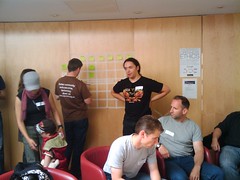
Thanks to the sponsors:
Jessica Rubart Gives Suggestions For Tinderbox Collaboration
Following on my series of posts about collaboration and Tinderbox (especially the one about patterns for teams to follow), Jessica Rubart sent me this truly staggeringly-fabulous set of suggestions. Jessica is an experienced team manager, and a researcher on the use of Tinderbox-like spatial hypertext for team-based activities. Her latest project (brilliant) is an app which uses spatial hypertext to plan Scrum Meetings (more about scrum).
University Lives Collection Page Launched
Over the weekend, the World University Project site launched an announcement of the University Lives Collection: The University Lives Collection is assembling snapshot of global student experience in our time.
Students worldwide are invited to produce and submit short ethnographic films about their university experience, using whatever technology they have. After their films are submitted online, and prizes have been offered for the very best submissions, the films will be catalogued and published online together with commentary by higher education experts. We are hoping to hear about a successful grant application by the end of the month. In the meantime, we're looking for alternative sources of funding. If you or someone you know might be interested in sponsorship, contact the project. The project is expected to reach around 5k universities worldwide. We're looking for sponsors to:
Collaboration with Tinderbox
This is the fourth post in a series on collaborating with Tinderbox and version management software. Previous posts discussed:
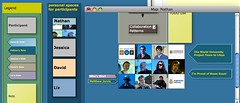
This post explains some practical ideas for how to actually use Tinderbox for collaborating, a template file on github, and lots of screenshots. Contents of this Post
When Not to Use Online Collaboration This post is about collaborating online, when the participants are in different places or working at different times, and need use of a shared repository for their document. If you're all in the same room, use a scribe. Mark Anderson, Robert Brook, and I have all found Tinderbox to be great help in meetings. This kind of collaboration really needs only one Tinderbox user. The Tinderbox Collaboration Template Ever since around 2004, when my brother and I gave a joint lecture on Parliamentary Procedure (fun!), and prepared the lecture by emailing Tinderbox files around, I have been collecting ideas on how to work together on a single Tinderbox document. The Tinderbox Collaboration Template includes the basics which I find helpful for any collaboration:
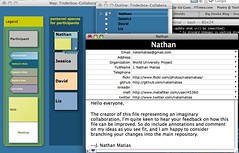
Workflow Overview To set up the template, you can either fork the project on Github, or check out the project, and push it to the repository of your choice. From that point, you do the following things to set up the Tinderbox file with your team:
When actually collaborating, the workflow looks like this:
Recognizing Changes in Diff GitX will show you changes you have made. GitHub will show you changes which others have made. Since GitHub and GitX only know about XML and don't understand Tinderbox, the output of diff can be confusing. 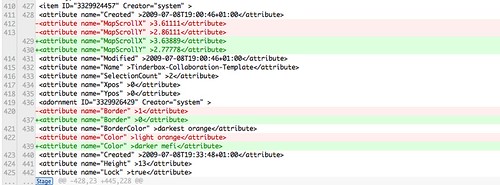
Over time, you will can a sense for what it all means. I hope these screenshots of diff can help give you a head start:
Patterns for Collaborating with Tinderbox The following set of recommendations are based on my experience, so if you have further idease, please write.
Git, Tinderbox, and Online Repositories
This is part three in a series of blog posts on backup, version control, and collaboration using Tinderbox. Prior posts include: This post will explain how to use an online repository, and how to collaborate with others. The next and final post will suggest some patterns for multiple users to collaborate online using Git. Online Repositories: Github, Unfuddle, and Codebase In addition to using Git to track the history of your own materials, you can also use it to share your materials with others and collaborate with them. Many good online services exist to make this task simple. Three that I like are:
Good Explanations on how to use Github Well, I was going to write something about setting up a github account online, but then I found these two excellent resources:
Using those resources you should be able to:
The online services themselves are very helpful (especially Github) and will walk you through each step. Especially with Mathai's article, you should read it thoroughly before starting, because he often explains the simple option only after explaining the complicated way in great detail. If this all seems too technical, hang in there. Once you set up the online repository as described in these articles, you can still continue to use GitX in the same way I described before. Once you have set up a remote repository, you will only need to use the Terminal in order to run two commands: git pull, to fetch the latest version from github, and git push, to update Github with your latest commit. This will be easier if you installed Shell Here, earlier. If you have, simply:
Backing up and Version Tracking With Git
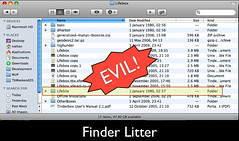
In my last post, I explained why using Tinderbox properly with version management software has been tricky. In brief, two Tinderbox files can be identical in content, and yet have a very different file structure. That has confused tools like git and Subversion, which expect changes in the files to indicate changes have been made to the document. This post will explain how to use Git to back up and track the version history of your Tinderbox documents. In the post after this one (which I will post this weekend), I will demonstrate how to collaborate using Github, Unfuddle, or some other online repository. The final post in this series will look at specific options for using Tinderbox with Git. ** * **
Preface: Ways to Share and Back Up
** * **
Step 1: Obtain Git There are two ways to install Git on OSX:
sudo port install git-core
You should download GitX, a very helpful tool. You will definitely want to get "Shell Here", by John Daniel and Marc Liyanage, since you will probably end up using the Terminal at some point or other. This button, when you add it to the Finder, will open a Terminal in the current finder window (installation explained here). Step 2: How Git Works (note: why read my blog post when you can read Swicegood's helpful book, Pragmatic Version Control Using Git ?) Most of what you need to do will happen within GitX. There is also a helpful article on the GitX website, which is slightly more helpful for people who already have repositories.
This post is long enough, and I need to prepare for Hypertext 2009. I will write from Milan late next week about how to collaborate using Git. There will have to be a fourth post about how to use Tinderbox with Git.
Tinderbox and Version Management
Earlier this month, I took a careful look at version management for Tinderbox files. My paper at this year's Hypertext conference will be about comparing spatial hypertext collections, so I was curious to see just how well Tinderbox worked with existing solutions, such as git and SVN. Badly, it turns out. But it's not the fault of Tinderbox. ** * **
Tinderbox files are stored in XML, a plaintext format which is easy for other programs (like my Web Viewer) to load. In theory, the Tinderbox XML files should work well with Version Management software. The tools are designed for plaintext, and Tinderbox files are plaintext. Perfect! Unfortunately, the XML standard breaks some assumptions of version control systems. In most plaintext formats, the order of the lines is significant. Code is executed line by line, so software such as git and SVN treats the reordering of lines as a change. In some parts of XML however, the order of lines is insignificant. In those cases, changing the order of the lines does not imply a significant chance to the XML. Such changes confuse version tracking systems. Tinderbox follows the assumptions of XML. Two saves of the same tinderbox can look very different. As a result, git and SVN get very confused. This flickr gallery demonstrates just how confused version control systems can become: 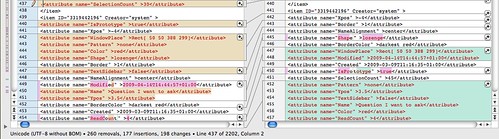 I discovered this issue in advance of Tinderbox Weekend London, where I was speaking about version history, backups, and collaboration with Tinderbox. So late on Saturday night, Mark and I had a conversation at Spoons (yeah, I know), and he offered to look into it. Last week, I had a chance to look at beta versions of the next release of Tinderbox. These betas output consistent line order, and work smoothly with the version control systems I have tested. (in the next post, I explain how to set up and use Git on the Mac)
Meditation on Christ as King
of all the ways you have given us to understand your care for us-- Shepherd, brother, refuge, fiancee, morning sun, friend. perhaps none is as troubling as God the King Even we your church, [who have committed to risking all to follow your rule ] prefer autonomy, though your loving decrees are at our fingertips ** * **
We are your citizen ambassadorsyet we tend to mistrust kings preferring ideologies, democracies, bureaucracies instead of total power We worry about bloodshed and oppression caused by kings, and you are a God of bloodshed - even Jesus spoke of presiding over the slaughter of those who resist his rule If you were not righteous we would be just to resist your rule even if this world were rightfully yours But we see that our sins, our rebellion the rebellion of the devil, and the curse have polluted the world with great ills and injustices and that the world you made will only be restored through your righteous judgment and loving rule not ours. Help us come to grips with your loving kingship. Help us, like Christ, humble ourselves in your mission of mercy, sacrificing our interests in love, generosity, and gospel witness to grow that future multitude which will celebrate your power and love in the heavenly kingdom Without your grace, we are corrupt ambassadors. Correct and guide us in love and truth and we will praise you, our chief hope in a troubled world, even as we struggle to understand and accept you, now, and forever, Amen.
The Coffeehouse
It is spring. I am in a dusty little cafe, tucked into a corner of art-deco, post-industrial America: the rafters are lined with a few hundred hanging coffee mugs, above scattered tables and scattered people-- old books, old laptops, an out-of-date menu on the chalkboard. Quote of the week: "I thought Goth was over," by "Acey". Next to it, scuffs of chalkdust form the shape of a rose. The barista is writing about Barthes, dictionary open. A dude in the corner is working on a short story. He's covered in tattoos, and his extremely relaxed girlfriend's kisses. A couple of old hippies are reminiscing about that time when they truly *experienced* pure music. "I wish I had a tape recorder back then," one of them says. Someone new walks into the cafe. A head appears from behind the cloudy-grey ibook in the couch. "Hey- I remember you from City View; You know, my second, third, and fourth first drafts were all written there. A cup of coffee, an appetizer, a few cigarettes, and some beers into the evening, and there you have it. 3am. I write everything in notebooks, you know." "Badass." I had forgotten what it's like to be around people who read, write, and think about ideas out of raw thirst.
Departure
Tonight, ater performing for the wedding of my friends Paul and Solveig, I will be leaving the UK for two weeks. The implications of this are:
See you in mid-June!
Literary Studies Now
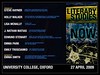 Over the next few weeks, I will be posting about this interesting gathering- drawing from my own notes and including text, commentary, and bibliographies from the other attendees. Feel free to participate in this conversation by emailing me.
Wagn: A Stretchtext Wiki
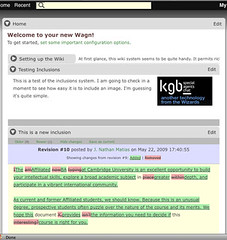
I think that Wagn, a Rails-based wiki, may help us stay DRY while providing handy tools for monitoring the state of information within the wiki. Wagn is a card-based wiki. Cards can link to or include information from other cards. Comments may also be added to cards. Cards have a type. For example, the image type makes it easy to upload images into a specific document, and also to share that image into several documents. The file type works similarly. One of the most useful types is "search". Using this feature, it will be possible to embed a search into any document. For example, I could create a home page for my account which automatically searches for "chat", "performance test", and "user interface". When I log in, I would then be able to see recent changes to documents referring to those topics. Oh, it also does rich text editing, which is a nice plus when you're in a rush.
Unhelpful Visualisations
I have been posting an occasional series to the office email about unhelpful visualisations. Having been fascinated by good qualities of The Cambridge Phenomenon influence map (1) (2), I then wrote about the Star Wars influence map: This influence map tracks the same kind of connections as the Cambridge Phenomenon one I sent out a few weeks ago. Except in this case, people, organisations, and projects are given the same status. Overlapping dotted lines and many unabeled link-types produce a confusing diagram. We can guess the nature of the relationship between two connected items (it's a guess because there are not labels), but it's not possible to know the relationship among three connected items. Lines seem to have directionality, but it's hard to know how that works, especially when lines directly intersect around nothing in particular. It's a pretty diagram, and it effectively communicates its point. Although the function of such graphs is to support and illustrate that point, the unclear presentation doesn't satisfy far beyond the initial impression. Today, I came across another unhelpful diagram: a history of information, a stacked graph which apparently displays data on media users since 1800. This beautiful and impressive diagram shows the transitions between epochs of news history: newspapers slowly supplant word-of-mouth, television and radio start edging in, and by 2020, thin bands of online options -- websites, blogs, social networks, social news, and targeted news-- completely supplant the old world. The design elements of authority are all there to support belief in a coming future of targeted news: evenly spaced labels, vertical bars for each label, and specific datapoints for each medium for each labeled year. The graph tells the whig history of media as a story of inevitable progress from one new medium to the next. Next to the progression of newspapers, television, and websites, social news and targeted media look like sure winners in the next decade. The graph, however, is a fabrication. Baekdal cites no actual sources for his graph(although he says the last 10 years are based loosely on what he has seen from "probably" 1000 surveys he has conducted. For data about life before 1990, he interviewed people and googled some stuff). But even if it were properly researched, it would be deceptive at best:
To be fair, there is no way to design the graph correctly. It is simply not honest to present non-quantitative opinions using means reserved for quantitative information. Although he argues in the comments that his graph is based on interviews, surveys, and "careful analysis", he finally admits that the "graph does not illustrate the size of the different forms of media. It illustrate their importance." P.S. Notice how the color selection subtly supports Baekdal's argument. Newspapers, radio, and television have colors which contrast each other, while the electronic media "websites, blogs, social networks, and social news" all have similar colors. The eye naturally groups them, contrasting them strongly with television.
This Blog?
Over the last year, I have been refocusing the nature of my writing. Since I studied at Cambridge, I have spent much more time focusing on individuals. Blogging can seem to be about the blogger, while writing emails lets me focus on others more easily. Unfortunately, friends who live in other places have been at a loss. Furthermore, some of the more polished things I have produced over the last few years need to be archived. Email's most tempting feature is the potential to permit multiple identities. Blogs encourage integrity because everyone sees the same one. People assume the written word is your final word. Questioned orthodoxies and scandalous thoughts can safely be shared with those best prepared to help- but there can be a strong temptation to keep keep ideological secrets. Then there are the embarrassing posts. First, the ones that will never leave the massive "Drafts" area. Then the ones that did. I prefer however to be uncomfortable with what I have said and done. Keeping them online forces me to remember and pressures me toward honesty and integrity. More recently, my work for the World University Project, Emberlight, and the knowledge Generation Bureau have reconnecting me with the wider world in exciting ways. While I don't expect to blog regularly, I expect to resume posting things of interest when appropriate. |
Copyright © 2006 J. Nathan Matias. Want to use it? Just ask.